
TIT-WP-2026-01. Case study (instrumental)
From Procurement to Production: Building Institutional AI Production Capability Through Edge Computer Vision Deployment in a Nigerian University
- Oluwatayo Winkunle, Techlytics Institute of Technology, Lagos, Nigeria
- Presented at
- 1st International Conference of the University of Ibadan School of Business
- Track
- Track One: AI, Digital Innovation and Emerging Technologies
Pending peer review and journal publication
Abstract
Purpose
Nigerian institutions largely acquire artificial intelligence through procurement, which delivers working systems while suppliers retain the capability to build, adapt, and govern them. This study asks whether institutions can deliberately develop AI production capability, and what constrains its development.
Design, methodology and approach
Instrumental case study of an applied AI engineering programme at a Nigerian federal university that admitted fifty students and graduated twenty-seven, delivered in twenty-five contact hours. Evidence comprises entry diagnostics, delivery records, dataset and model records, two deployed systems, a post-programme assessment and the laboratory handover record.
Findings
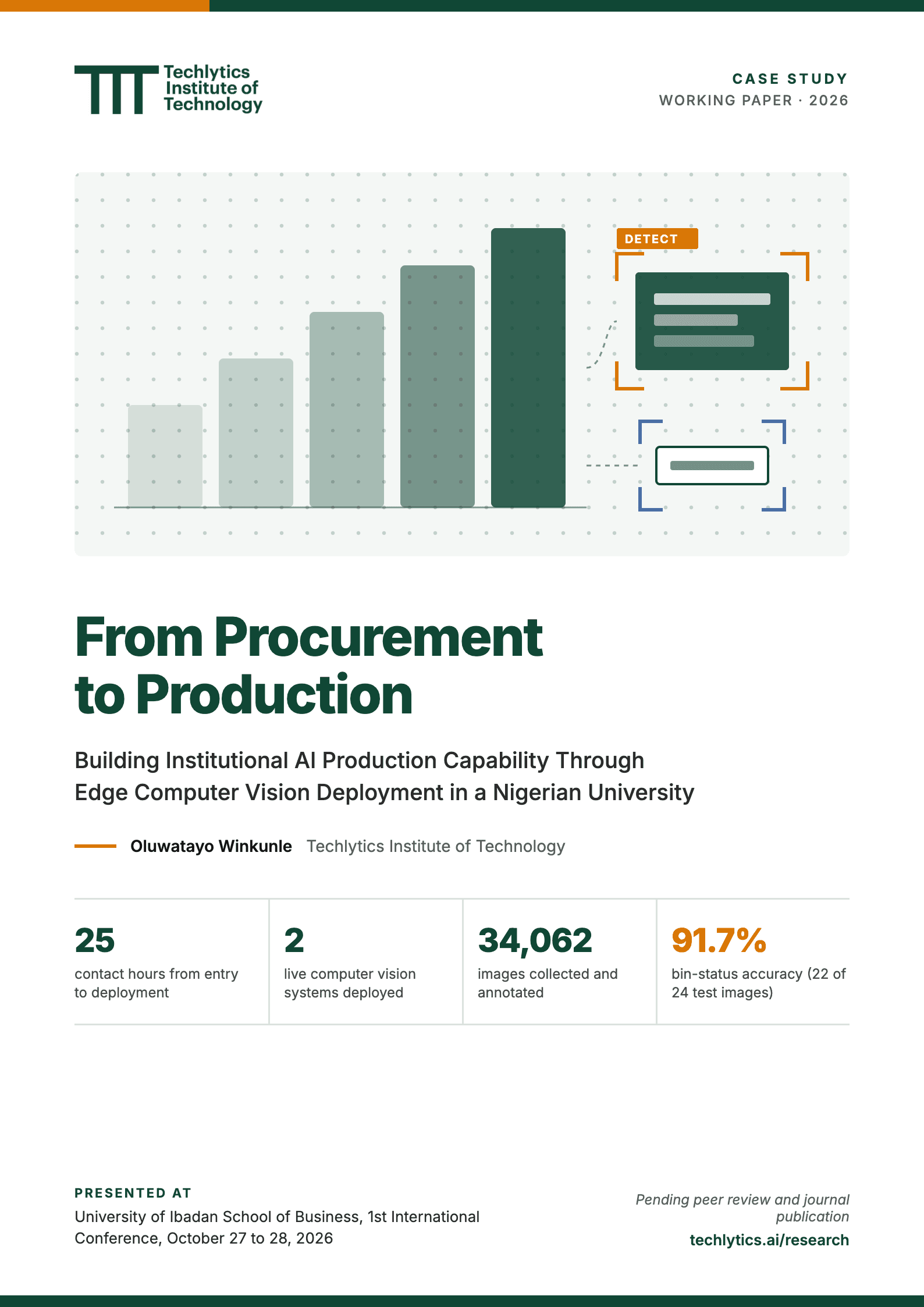
At entry, 52% of respondents had never used a command-line terminal and 49% had written no Python independently. The cohort annotated 34,062 images and deployed two computer vision systems on edge AI compute hardware with live dashboards. The licence plate pipeline achieved sub-50 millisecond inference; the bin-status model correctly classified 22 of 24 test images (91.7%). Equipment ownership and access governance passed to the university.
Implications
Universities, sponsors and policymakers can treat AI capability as an institutional asset formed through owned compute, local data and deployment targets, and can write capability transfer into AI procurement.
Originality and value
The study extends the technological capability tradition to AI and proposes a five-layer institutional AI production capability stack covering compute ownership, data capability, engineering skill, applied deployment and governance capacity, with testable propositions. It argues that capability is evidenced by artefacts produced, and that formation is bounded by contact time and annotation throughput.
Key findings
- AI production capability can be built from a low baseline in a short time. At entry, 52% of students had never used a command-line terminal and 49% had never written Python on their own. Within 25 contact hours, the teams built and deployed two working computer vision systems with live dashboards.
- Both systems ran entirely on hardware the university owns. The licence plate system ran inference in under 50 milliseconds. The bin-status model classified 22 of 24 test images correctly (91.7%). Neither system needs a cloud service or a supplier contract to run.
- Capability becomes institutional only when ownership and governance move to the institution. The university took ownership of the laboratory equipment at handover. The Dean, two Heads of Department and a named laboratory lead now govern access to it. Wider governance, such as model evaluation, data protection and audit, is still to be built.
- Contact time, annotation throughput and student availability set the limits. Twenty-three of the fifty admitted students did not graduate. The programme’s account puts most withdrawals down to industrial placements (SIWES) and family commitments, so the programme calendar has to plan around both.
Keywords
- AI production capability
- edge AI deployment
- computer vision
- institutional capability development
- Nigeria
How to cite this paper
Winkunle, O. (2026). From Procurement to Production: Building Institutional AI Production Capability Through Edge Computer Vision Deployment in a Nigerian University. Paper presented at 1st International Conference of the University of Ibadan School of Business, Track One: AI, Digital Innovation and Emerging Technologies. Techlytics Institute of Technology, TIT-WP-2026-01.
Read the full paper
Tell us who you are and we will send you a copy of the PDF, 23 pages.
About the author
Oluwatayo Winkunle
Oluwatayo Winkunle builds the engineering capability African industries need to move AI out of experimentation and into systems that run in production. She is Founder and Chief Executive of Techlytics, which advises executive teams on enterprise AI delivery and builds applied engineering capability inside corporate and academic workforces. She is also a Director of TNE, which deployed the first sovereign air-gapped AI research laboratory at Abdul-Kadir Kure University, Minna. Her work spans applied AI engineering programmes at the University of Ibadan and the digitisation of Nigeria’s compressed natural gas operations.